How to stay motivated and achieve flow state
This is a post in progress. You should not be seeing this. I’m not kidding..
Disclaimer: I promise to make up for the poorly named article with actual content. I am not an expert on psychology or philosophy, but I consider myself an amateur who loves to think. Most of the article is a summary of my conclusions derived from the book “Flow: The Psychology of Optimal Experience” and from experiences of people around me, including myself.
The entire article is a bunch of questions that provides a logical step through my entire thought process. Hopefully this acts as a no BS, cut to the point content.
What is motivation and why stay motivated? Motivation is a state of mind that drives us to do a particular task with relative ease. This should not be confused with the amount of effort or skill required to do something. A highly motivated entrepreneur will still put in tremendous effort towards building a product while lack of motivation can make simple tasks look herculean. Since motivation is a state of mind and is independent of the effort/skill required to perform a task, we can potentially “game” our minds by optimizing it for “useful” tasks, which will hopefully improve our quality of life.
Okay but…. What are these “useful” tasks? Why am I not intrinsically motivated about these tasks? If we are essentially “gaming” our minds, are we really maximizing happiness from our minds perspective? Are you trying to make us join a cult? These all are all extremely valid questions to ask(except for the last one, you did pledge allegiance by clicking on the link) and we’ll try to answer them one by one.
Useful tasks you say? The book calls the state of mind during such tasks as a flow state. This is best described by the diagram below but the mathematical graphs don’t do justice to the beauty of the state.
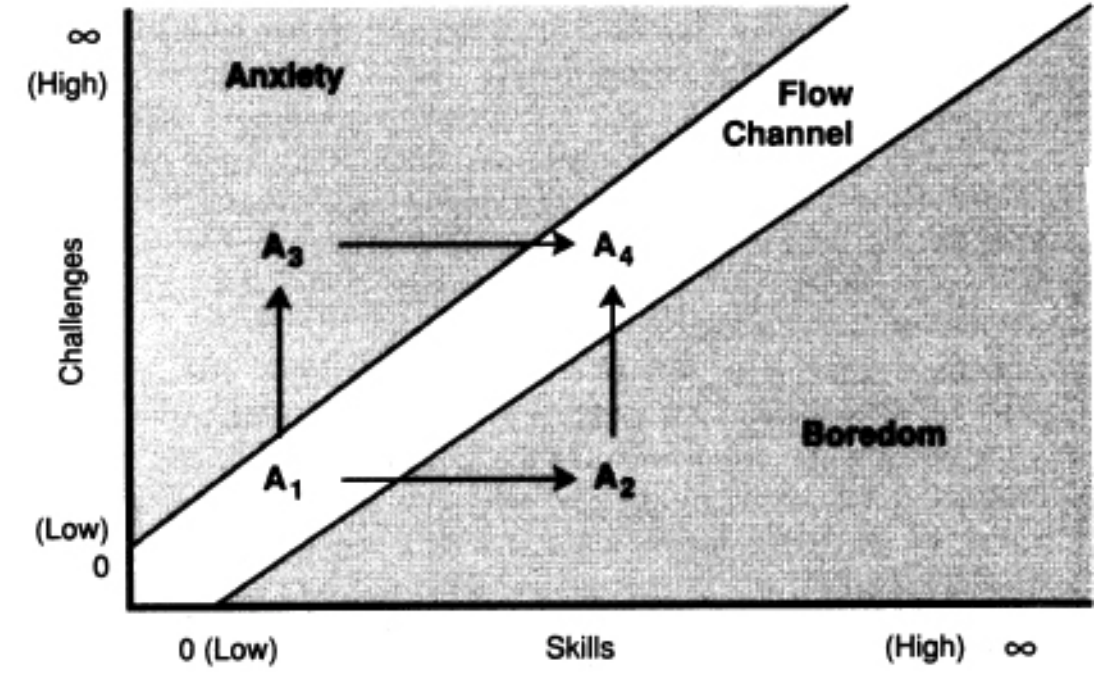
A flow state is when your mind goes with the flow of a task. For the duration of the state,the entire consciousness of mind is dedicated towards the task, so much as to often forget passage of time and other external factors. In this state, the skill and challenge of the task at hand are high enough to stimulate our at most attention and focus, giving a lasting sense of joy from the activity.
Flow state sounds great but how do we know that these activities can improve quality of life? Mathematically, our minds can process only so many bits every second (try listening to 2 people at once). This implies we can experience upto a fixed number of expressions (or bits in neurons) in a lifetime. One way to define the quality of life can be maximizing the bits processed by the brain over a lifetime, in which case doing highly skilled tasks might make more sense than sitting at the Bahamas eating strawberries. Maximizing bits sounds ridiculous and maybe 50 years later when Elon puts a chip in your brain, you might just experience all of humanity in a blink of an eye, who knows! So let us compare how happy we feel in flow state compared to watching our favorite TV show. I agree watching the suspense break in front of your eyes can be quite enthralling, but I can argue that it’s nowhere as satisfying as completing a hard fought task at your job. It is a difficult comparison since our society has a grim picture of working/jobs that treat it as a means to an end. It can be argued that while watching TV, all you do is avoid consciously thinking about anything; it has low barrier to entry. Hence it is easy to start watching and virtually never stop, giving a false sense of enjoyment.
Okay maybe I’d like to be in a flow state, but are these special tasks?
Ideally speaking, an individual can create complex tasks out of virtually anything, given he realizes the importance of flow or more aptly, channels motivation towards it. However there are some activities that can help create flow easier. Characteristics of activities that are likely to induce flow state:
- high challenge activity requiring high skills (gives a sense of accomplishment and meaning to it)
- clear goals (keeps driven and sense of joy after attaining the goal)
- tangible feedback (helps climb the graph and move towards the flow state)
So the next time you decide to change jobs and sort the listings based on fat dollar bills, try keeping the above points in your mind. I do believe that money (and standard of living) can help in inducing flow, just like a better job but it should not be confused as an end but only the means.
Okay, so maybe I’m convinced that watching TV is really not making me happy and I should invest more time in flow state. But it seems like I need a ton of motivation to reach the flow state. How do I get motivated and also, does my mind really want it? Reiterating these questions help us understand the underlying chain of thoughts we have followed.
Let us answer the latter. Seems like we may be gaming our minds to do something it really seems against. “I understand that watching TV is really not the best use of time, but at least I’m not gaming my system to juice out every last bit of consciousness?” Its funny how the society can change minds. A 100 years ago, we did not want to travel overseas for vacation or watch Netflix, primarily because we just couldn’t, which implies its not hard-coded into humans (I’ll later discuss that even blindly following our hard-coded instincts might not optimal). We do things in a certain way because we have grown in a society that does that. In a capitalist society, you are encouraged to buy material possessions -> which requires accruing wealth -> which is result of work fueling the economy. This is an over simplification to the extent it might make a lot of people angry, but I want to convey that we might be corrupted by societal fundamentals and have wrong notions of leisure in our minds. This is not to say that you cannot contribute to society by staying in the flow state,in fact an argument against it can be easily made if the activity is, say your job.
Alright , alright .. How to stay motivated and achieve flow state? We have finally reached the question you came looking for. As every other article on the internet, I have successfully lured you into reading countless paragraphs just to reach the core you actually came for. The answer to saying motivated is actually pretty straightforward and its NOT going to be an aha moment!
Align your goals to flow state
Say what? Growing up, money has possibly been the biggest motivator for me but not the only one. Had it been the only motivator, I would have taken side jobs,dropped out of college (ouch!) or never went to one in the first place. It is not to say that people who do that are solely driven by money; it does not work both ways. Other fairly common end goals like getting educated in an elite university and earning a living via a “respectable” job have played a pivotal role in shaping crucial life decisions. This is not to say that I never experienced flow- there were times that my goals aligned with tasks which had perfect flow inducing characteristics which helped me do well in some aspects of life. However since the goals are indirect, even doing possible flow activities at times has been filled with drudgery, without deriving pleasure from it and relying on worthless entertainment channels with zero entry barriers to relieve stress.
The story of my life is not so grim as pictured over here (or is it?) but the key takeaways are:
- Have direct goals towards flow state (not money,status,show off)
- Sometimes flow state can be achieved by indirect goals fueling motivation but this might not be optimal
How does success work with flow state? Stay tuned!